
Repair vs. Replace
Using Your Reserve Fund to Protect Business Continuity
In Part 1 of this series, I shared why every small business should have a Contract-Ready Reserve Fund, also known as a Business Stability Fund. In Part 2, I walked through how to set up and use the funds in a reserve account. But full transparency: building that stability takes time. Last week, I shared that when my equipment failed, I didn't have my full reserve in place yet and had to rely on credit. Today, I want to show you the 'Real Life' math I used to decide whether to repair or replace that machine—and why this experience solidified exactly how I'll be using my Contract-Ready Reserve Fund moving forward.
The Situation
A few weeks ago, a hard drive failure warning popped up on my screen while I was working on a client project. In the world of contracting, equipment downtime doesn’t just stall your day—it can stall your project milestones and impact your compliance readiness.
When I spoke with my computer repair tech, she recommended a deep-dive performance audit to confirm the problem. My first reaction, and the recommendation from several business friends, was to replace the computer entirely. But before spending $800–$1,200 on a new desktop, I needed to decide whether to repair or replace.
I rely on this machine for essential operations:
Document preparation and compliance filing
Content creation and educational resources
Client projects and strategic consulting
Day-to-day business operations
The Comparison
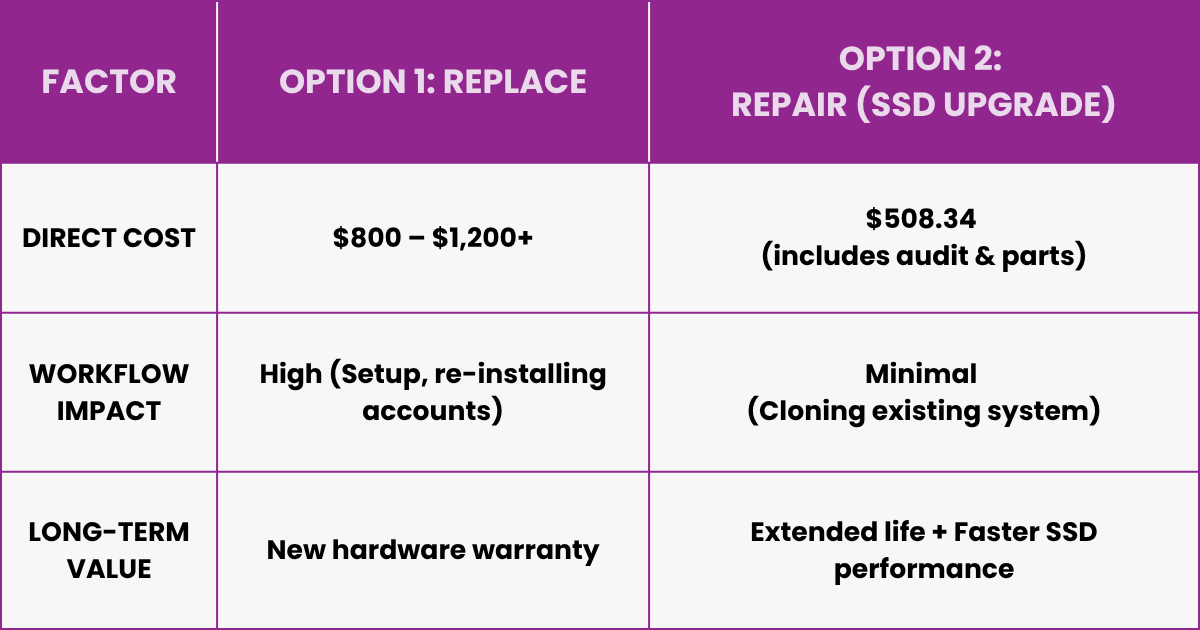
To make a clear, strategic decision, I looked at the true costs of both paths:
The Decision
The initial performance audit was $300. As expected, the drive was failing. Even though my tech hesitated before sharing the grand total of $508.34 for the repair and upgrade, I approved the expense immediately. Why? Because I had factored in the hidden costs of replacement—the hours spent shopping, reinstalling software, and adjusting workflows—which pushed the real price of a new machine closer to $1,500.
Repairing my desktop was the better business choice. It extended the life of my system, preserved my workflow, and minimized downtime.
The Bigger Lesson for Subcontractors
A Contract-Ready Reserve Fund is not just for emergencies. The goal is to give yourself the ability to make clear, strategic decisions without delay. In government contracting, the same readiness systems that help subcontractors become compliant also help them stay competitive. Financial readiness supports better decisions on and off the job site.
The 30-Second Decision Filter
Before you rush to replace failing equipment, ask:
1. Can this be upgraded? Will a repair extend its life by 12–24 months or longer?
2. What is the total cost of replacement? Does this include the time lost to setup and training?
3. Do I have the funds available to act without delay?
4. Will new equipment significantly improve output? If not, repair is likely the strategic move.
Final Thought
Financial stability is not about avoiding expenses; it is about being prepared for them. When you are prepared, you make decisions based on what makes sense—not what feels urgent.
About Stephanie:
Stephanie Clark-Ochoa is a Government Procurement Strategist and founder of Clark-Ochoa Business Services. Through Help 4 LA Subs, she provides practical tools and insights to help micro and small businesses in the Greater Los Angeles area become government-ready and thrive in public contracting.
Disclaimer: This post is for informational purposes only and does not constitute legal, financial, or professional advice. Please consult a qualified advisor before making any business-specific decisions.
🔜 Next Week on the Blog: How a 15-minute weekly money habit can help you stay financially prepared and contract-ready.