
Why Predictable Business Expenses Still Catch Small Businesses Off Guard
A simple cash flow system to help small businesses in Los Angeles and Orange County stay stable, prepared, and ready for opportunity.
If you’ve ever been blindsided by a business expense you knew was coming, you aren’t alone.
I see this all the time with micro and small businesses across Los Angeles County and Orange County, especially those trying to move into government contracting. The issue usually is not that the business is failing. It is when the cash flow gets tight at the wrong time.
A software renewal charge is processed. Insurance comes due. A license fee posts. Website hosting renews.
None of it is unexpected. But many business owners still end up scrambling to cover it.

Routine expenses like software, insurance, and renewals can create pressure when they hit at the wrong time.
The Problem Is Not the Expense. It Is the Timing.
In my consulting work, I have seen businesses struggle with predictable annual costs like:
software subscriptions
insurance renewals
website hosting
license fees
certification costs
professional tools
These are normal operating expenses. But when cash flow is uneven, even routine costs can create stress.
I have dealt with this in my own business, too.
For a long time, I handled annual expenses the same way many small business owners do: I put them on a credit card and paid them off over time. That worked, but it also created pressure. Even with a steady income, the timing did not always line up.
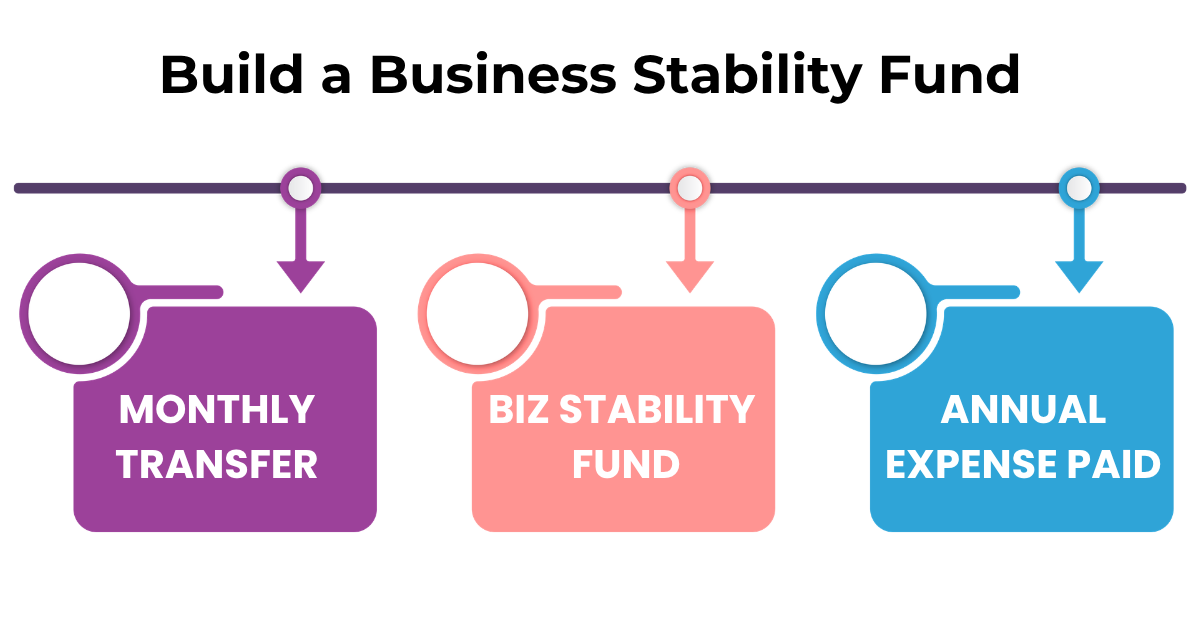
A business stability fund helps turn predictable annual expenses into manageable monthly planning.
A Simple Fix: Build a Business Stability Fund
That is why I created a separate high-yield savings account just for annual business expenses.
I call it my Business Stability Fund.
The purpose is simple: save for recurring annual expenses before they hit. My target is $2,500, which covers about $2,000 in expected expenses plus a small cushion.
Each month, I transfer money into the business stability fund. When an annual charge posts to my credit card, I transfer the exact amount from the business stability fund and pay that amount on my credit card.
That system helps me avoid three things:
last-minute scrambling
lingering credit card balances
unnecessary cash flow pressure
It is not complicated, but it makes a real difference.

From job site support businesses to professional services firms, small businesses benefit from stronger financial systems.
What This Looks Like for Small Businesses in LA and OC
I have seen this same issue affect both construction trades and professional services subcontractors.
A trade business might be trying to keep work moving from one job site to the next while also managing insurance renewals, estimating software, and other back-office costs.
A professional services subcontractor might be juggling accounting software, license renewals, and delayed payments while trying to stay ready for work with a city, county, school district, or California state agency.
Different industries. Same pressure point.
And in high-cost regions like Los Angeles County and Orange County, that pressure can build fast.
Financial Stability Is Part of Readiness
If your goal is to pursue public-sector work in places like Los Angeles, Long Beach, Santa Ana, or Anaheim, or with California agencies, financial stability matters.
Prime contractors and public agencies want subcontractors that are organized, responsive, and able to manage routine business obligations without constant disruption.
That is why I talk so much about readiness systems.
The same readiness systems that help subs become compliant also help primes stay competitive and manage their teams.
An annual expense fund may seem basic, but it supports the kind of consistency that makes a business easier to trust, easier to work with, and better prepared for growth.
Start Small and Build the Habit
You do not need to fully fund this account overnight.
Start with what you can. Even a small monthly transfer can help reduce stress and give you more control over your cash flow.
For many micro and small businesses, the first win is not building a huge reserve. It is creating a system that keeps predictable expenses from turning into emergencies.
Strengthen the Foundation Before You Chase Growth
Before you focus on growth, take a moment to strengthen your foundation.
Because a stable business is not just one that earns revenue. It is one that can handle its obligations consistently, predictably, and without panic.
Stability may not be the most exciting part of business growth, but in my experience, it is one of the clearest signs that a business is becoming truly ready.
About Stephanie:
Stephanie Clark-Ochoa is a Government Procurement Strategist and founder of Clark-Ochoa Business Services. Through Help 4 LA Subs, she provides practical tools and insights to help micro and small businesses in the Greater Los Angeles area become government-ready and thrive in public contracting.
Disclaimer: This post is for informational purposes only and does not constitute legal, financial, or professional advice. Please consult a qualified advisor before making any business-specific decisions.
🔜 Next Week on the Blog: How I Set Up My Business Stability Fund (Step-by-Step for Small Businesses)